Second LOCATEE stakeholder workshop in Piraeus
July 1 2026
The event was attended by 17 participants and provided an opportunity for citizens, experts, researchers and municipal representatives to exchange knowledge and discuss how local authorities can more effectively identify and support households experiencing, or being at risk of, energy poverty.
The workshop was organised in the context of the LIFE LOCATEE project, which aims to strengthen the capacity of municipalities to identify, measure, monitor and address energy poverty in private multi-apartment buildings, while facilitating the implementation of building renovation measures for vulnerable households.
Peggy Kaloumenou, representative of the Municipality of Piraeus and project coordinator on behalf of the municipality, opened the workshop and welcomed the participants. She briefly introduced the objectives of the event and highlighted the importance of stakeholder participation in ensuring that the tools and approaches developed through LOCATEE respond to the practical needs of municipalities and local communities.
The first presentation was delivered by Dr. Christos Tourkolias, an expert from the Centre for Renewable Energy Sources and Saving (CRES) and the National Observatory of Energy Poverty. His presentation focused on the national framework for addressing energy poverty in Greece and the methodological approaches currently used to identify and monitor energy-poor households.
Dr. Tourkolias introduced the policy context established through the National Action Plan for Energy Poverty and its integration within the National Energy and Climate Plan. He explained that Greece has adopted a comprehensive approach that combines social, economic and technical dimensions in order to identify households experiencing energy poverty more accurately and to support the design of targeted policy measures. Emphasis was placed on the revised European definition of energy poverty, which recognises that the phenomenon extends beyond low household income. Energy poverty arises from the interaction of multiple factors, including insufficient disposable income, high energy costs, poor energy performance of residential buildings and limited access to essential energy services required to maintain adequate living conditions. The presentation also introduced the national methodology developed for identifying energy-poor households. Rather than relying solely on conventional income-based indicators, the methodology combines information on household income, reasonable living expenses, required energy costs and the energy performance of dwellings. This approach enables a more comprehensive assessment of vulnerability and allows the intensity of energy poverty to be monitored across different regions of Greece.
Dr. Tourkolias further presented the role of the National Observatory of Energy Poverty, which supports the systematic monitoring of energy poverty through the collection and analysis of national and regional indicators. The Observatory provides evidence to support policy design and evaluates progress towards national targets for reducing energy poverty. The presentation concluded with an overview of the main policy measures included in the Greek Social Climate Plan. These combine short-term actions aimed at protecting vulnerable consumers with longer-term structural interventions, such as improving the energy performance of residential buildings, promoting renewable energy solutions, establishing one-stop-shop advisory services, and strengthening information, coordination and monitoring mechanisms. Together, these measures seek not only to alleviate the immediate impacts of energy poverty but also to address its underlying structural causes.
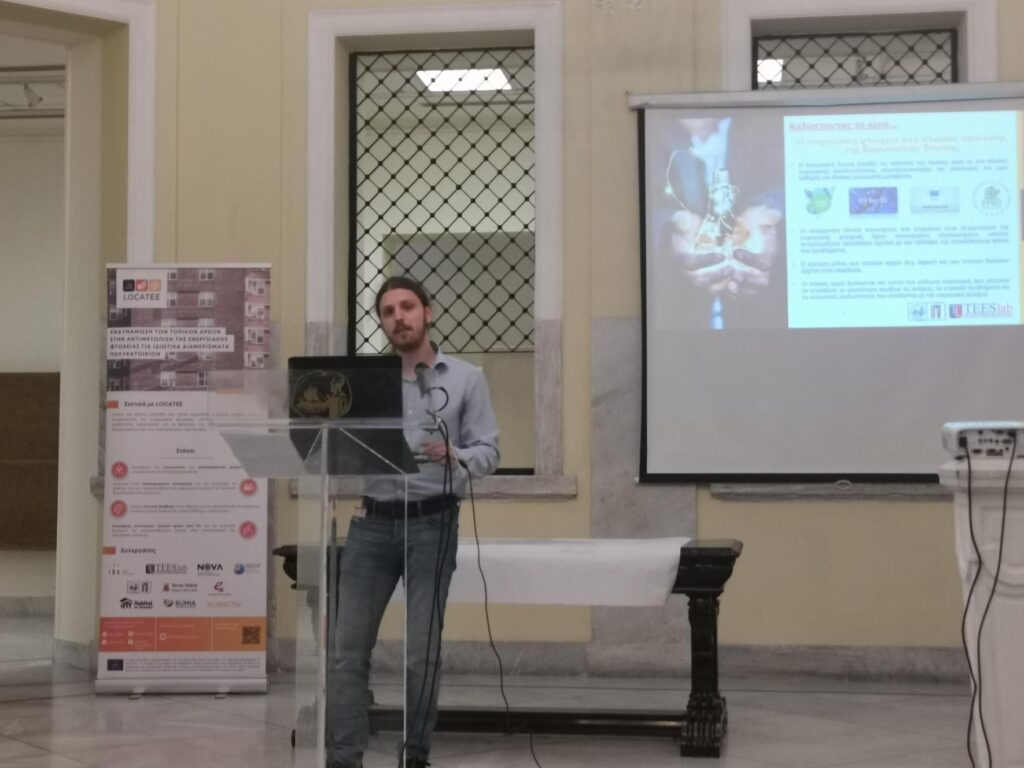
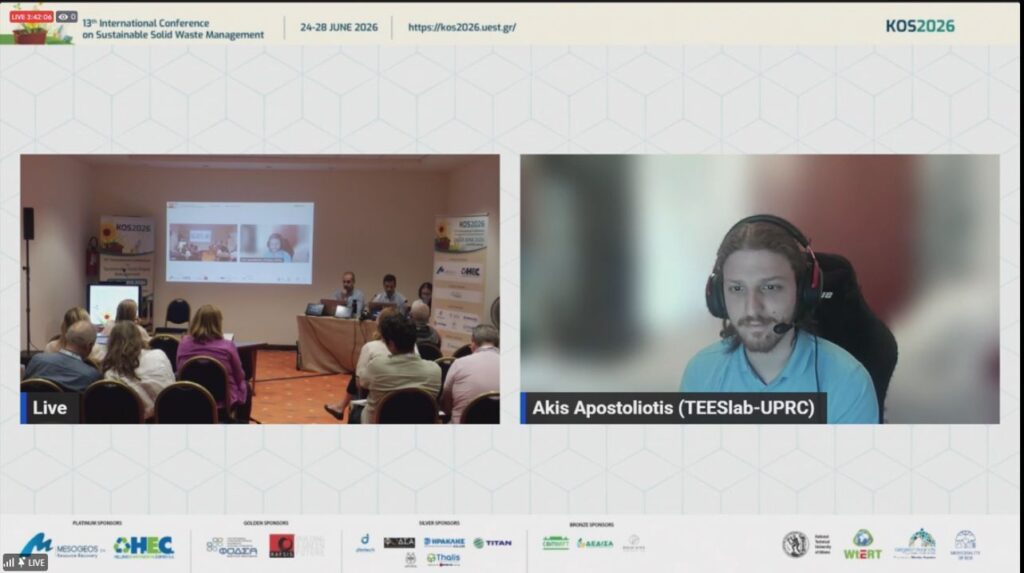
The second presentation was delivered by Akis Apostoliotis, researcher at the Technoeconomics of Energy Systems Laboratory of the University of Piraeus Research Centre. The presentation introduced the overall objectives and methodological approach of the LOCATEE project, with particular emphasis on the project activities being implemented in the Municipality of Piraeus.
Akis Apostoliotis presented the existing situation in Piraeus, including the building, socioeconomic and energy-related characteristics that may influence the vulnerability of households living in private multi-apartment buildings. The presentation highlighted the importance of combining information on household circumstances with data on the characteristics and energy performance of the residential building stock. The application of the Dynamic high-Resolution dEmand-sidE Management (DREEM) model in the Piraeus pilot was also presented. The model was used to analyse the energy performance of representative dwelling typologies and to assess the potential effects of alternative energy renovation measures.
The analysis can provide evidence on the potential impact of interventions such as:
The presentation further explored how the information generated through the analysis of the Piraeus building stock and the application of the DREEM model could be incorporated into the LOCATEE toolkit. Integrating building-level energy modelling with socioeconomic and energy poverty indicators could enable the toolkit not only to identify vulnerable households and buildings, but also to assess which renovation measures may be more appropriate for different dwelling typologies and groups of residents. In this respect, the toolkit could support the Municipality of Piraeus in moving from the identification of energy poverty towards the design and prioritisation of targeted interventions. For example, it could help municipal services identify areas with a concentration of vulnerable households, recognise inefficient dwelling typologies and examine the potential energy, economic and social benefits of different renovation measures.
Following the presentation of Akis Apostoliotis,the final presentation was delivered by Stathis Tourloukis, volunteer consultant/ citizen, who provided an overview of the policies, financial instruments and building renovation programmes currently available in Greece (e.g., “Exikonomo 2026”).
The presentation covered existing support schemes for improving the energy performance of residential buildings and assisting households in implementing energy efficiency interventions. In this regard, participants were informed about the eligibility criteria of each programme as well as about the programmes’ financing schemes. The presentation also addressed the practical difficulties that households and representatives of multi-apartment buildings may encounter when attempting to participate in renovation programmes. These difficulties may include complex administrative procedures, limited access to clear and reliable information, uncertainty regarding eligibility requirements, insufficient financial capacity, and the need to reach collective decisions among apartment owners.
The discussion demonstrated that the availability of financial programmes does not automatically ensure that vulnerable households can access and benefit from them. Households experiencing energy poverty may require additional technical, administrative and financial assistance in order to participate effectively in renovation schemes.
Municipalities can therefore play an important intermediary role by informing residents about available programmes, helping them understand eligibility and application requirements, directing them towards appropriate technical support and facilitating coordination within multi-apartment buildings.
A central part of the workshop was dedicated to an open discussion among citizens, experts, researchers and representatives of the municipality joining the event and NGOs regarding the development of the LOCATEE toolkit and Energy Poverty Monitoring System.
Participants discussed the features and functionalities that the toolkit should incorporate to maximise its practical value for the Municipality of Piraeus. The discussion highlighted that the tool should support evidence-based decision-making while remaining accessible to municipal staff and other end users. Among the most important requirements identified during the workshop were that the toolkit should:
Participants emphasised that the toolkit should not function solely as a technical database or data repository. Instead, it should operate as a practical decision-support instrument that enables municipal authorities to translate available data and modelling results into targeted policies and interventions.
The importance of a user-friendly interface was also highlighted. Municipal employees should be able to use the toolkit without requiring highly specialised technical expertise. At the same time, it should provide sufficient analytical detail to support evidence-based planning, the comparison of alternative interventions and the transparent prioritisation of vulnerable households and buildings. One of the most important outcomes of the workshop was the broadening of participants’ understanding of energy poverty. While income was initially identified by several participants as the main cause of energy poverty, the presentations and subsequent discussion demonstrated that the phenomenon results from the interaction of multiple factors. These include household income, energy prices, the condition and energy performance of the dwelling, the efficiency of energy systems, household energy needs, indoor living conditions and access to financial and institutional support.
This multi-dimensional perspective can be particularly important for municipalities. Identification methods based exclusively on income may overlook households living in highly inefficient buildings or households that reduce their energy consumption to inadequate levels because they could not afford to maintain acceptable indoor temperatures.
The workshop provided valuable input for the further development of the LOCATEE toolkit and Energy Poverty Monitoring System. It also contributed to a shared understanding of how municipalities can identify energy poverty more accurately, evaluate the needs of vulnerable households and design interventions that respond to the specific characteristics of the local building stock and population.
The event was organised as part of the LIFE LOCATEE project, co-funded by the European Union through the LIFE Programme under “Grant Agreement No. 101167621”. The project is also co-funded by the Green Fund.