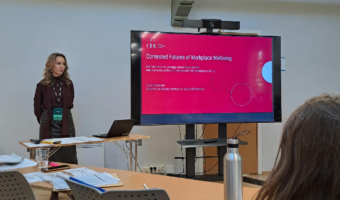
Zuzanna Kowalik at the International IREC/IWPLMS Conference in Oslo
September 21 2026
The conference brought together two international research communities: the Industrial Relations in Europe Conference (IREC), a network of scholars studying European industrial relations, and the International Working Party on Labour Market Segmentation (IWPLMS), established in 1979 to advance research on labour market segmentation and socioeconomic inequalities.
This year’s conference, held under the theme Confronting Inequality: The Role of Industrial Relations and Social Dialogue, focused on growing labour market inequalities, transformations in employment relations and the role of institutions and social dialogue in addressing these challenges.
Conference highlights: Keynote lectures
The conference featured seven keynote lectures by leading international scholars, addressing some of the most pressing challenges facing contemporary labour markets.
Jon Erik Dølvik, Research Professor Emeritus at Fafo, examined the resilience of Nordic labour market models after 30 years of integration into the European Single Market. He highlighted their continued distinctiveness and strong collective bargaining institutions, alongside emerging challenges related to labour mobility, wealth inequality and tensions between EU regulations and national industrial relations systems.
Richard Hyman, Professor Emeritus of Industrial Relations at the London School of Economics and Political Science (LSE), explored the relationship between economic inequality, employment insecurity and the growing electoral support for far-right parties across Europe. His lecture examined the erosion of traditional working-class identities and representation, as well as the interaction between economic grievances and cultural factors in shaping workers’ political preferences.
Jill Rubery, Professor at the University of Manchester and Director of its Work and Equalities Institute, discussed the contribution of segmented labour market theory to understanding economic inequality. She emphasised that wages and working conditions are shaped not only by individual qualifications but also by employer strategies, labour market institutions and barriers between different segments of the workforce.
Agnieszka Piasna, Senior Researcher at the European Trade Union Institute (ETUI) in Brussels, addressed the challenges of defining and measuring job quality in the context of digital transformation and EU social policy. She argued for a worker-centred understanding of job quality that prioritises workers’ health and well-being rather than treating better working conditions primarily as a means of increasing productivity and competitiveness.
Maarten Keune, Professor of Social Security and Labour Relations at the University of Amsterdam, examined the EU’s recent shift towards a stronger social policy agenda, including the European Pillar of Social Rights, new directives and financial instruments. His lecture explored the limitations of these initiatives, particularly the tensions between social objectives and the EU’s market-oriented economic framework.
Virginia Doellgast, Professor of Employment Relations and Dispute Resolution at Cornell University, presented research on the impact of artificial intelligence on worker power and trade union strategies, drawing on evidence from the telecommunications and video game industries. She discussed the risks associated with automation, algorithmic surveillance and work intensification, as well as opportunities for strengthening worker voice in decisions about the adoption and use of new technologies.
Christian Lyhne Ibsen, Associate Professor of Sociology at the University of Copenhagen, examined how generative and agentic AI are reshaping longstanding challenges in industrial relations, including workplace control, the distribution of economic gains and employment security. He proposed a human-centred approach to AI governance, emphasising worker dignity and agency, collective bargaining and multi-level regulatory arrangements.
Presentation on Social Dialogue and the Regulation of Psychosocial Risks
During the conference, Zuzanna Kowalik presented findings from her research on social dialogue surrounding the regulation of psychosocial risks in the workplace. The research is funded by the National Science Centre (NCN) under the PRELUDIUM grant scheme.
Her presentation explored the role of social partners in shaping regulations to prevent and mitigate psychosocial risks at work. The research examines how trade unions, employers’ organisations and public institutions engage in regulatory processes and influence the development of occupational health and safety policies.
The presentation contributed to broader conference discussions on the role of labour market institutions, worker representation and social dialogue in promoting safe and equitable working conditions.
Further information about the conference can be found on the organiser’s website: https://fafo.no/fafoconferences2026.