A fruitful spring in Warsaw!
September 1 2021
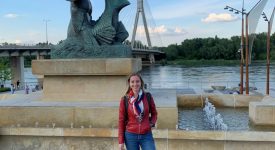
Carlotta Varriale, a PhD student at Bocconi University, was on her research visit in May as a part of the Youth Employment PartnerSHIP project. Carlotta Varriale is a third-year PhD candidate in Public Policy and Administration for Bocconi and a freelance economic consultant.
Carlotta was a part of the project team which also aims at building capacity in research institutions to implement evaluation studies of employment initiatives by creating a transnational research network on youth employment policies, internships for PhD students. Internships are directed to scholars from the countries participating in the project and are offered by six institutions taking part in the project consortium I.e. IBS (Institute for Structural Research from Warsaw, Poland, Budapest Institute for Policy Analysis (Hungary), Collegio Carlo Alberto (Italy), Foundation for Applied Economics Studies – FEDEA (Spain).
Carlotta’s job focused on analysis of big-data sets. She carried the tasks with great diligence adding her vast area of expertise into the subject. Apart from contributing to scientific research team, she had also an opportunity to visit Poland, meet people and get some impressions on the situation of labour market in both countries. Read what she has to say!
Institute for Structural Research (IBS): Please describe your stay in Poland during the internship.
Carlotta: Unexpected…I wasn’t expecting such an advanced, challenging, and interesting level of research and such a friendly environment despite the (soft) lockdown measures.
IBS: Did you have a chance to visit Warsaw or see Poland during your stay? What your impressions were?
Carlotta: I visited Warsaw and Gdańsk. I really liked the Wilanow Museum in Warsaw and the city of Gdańsk was also very precious. Yet, I was negatively impressed by the functioning of the trains system 🙂
IBS: Poland is working upon it 😊 Could you please describe the situation of young people in your home country in terms of employment?
Carlotta: In January 2020, before the first wave of COVID-19, the employment rate in Italy, was almost 60%. Over the past 5 years, the unemployment rate had so decreased from 12.1 to 9.7 percent. In 2008, before the financial and economic crisis, this rate had fallen below 7%. The youth unemployment rate, traditionally much higher than that of the overall population, has risen from 21% in 2008 to 31% in 2018, after hitting a peak of 46% in 2014. However, in 2019-2020 there was a downward trend, which led it to settle at 29%.
IBS: Knowing the Fund and especially Youth Employment PartnerSHIP project more particular, what is your opinion on the measures and tools offered by the project?
Carlotta: The collaboration among international students and researchers is for me a key asset.
IBS: In your opinion which obstacles make NEET out of the labour market in your home country? What tools could prove useful to resolve the main problems?
Carlotta: The main obstacles include the welfare state that was increased by populist parties together with a high share of illegal or black work and the tendency to live with parents until at least the 30s. Give incentives for the youth to move to live alone and help them find a job.
IBS: Thank you for sharing your impressions with us!
Read more about Carlotta Variale